
Combined interictal biomarkers
[Check out our poster below, on detection of combined interictal biomarkers with Halyzia®, from a recent conference]
Why combining interictal biomarkers may be the future of epileptogenic zone localization
For patients with drug-resistant epilepsy, successful surgery depends on accurately identifying the epileptogenic zone (EZ), the brain region responsible for generating seizures. Traditionally, this localization relies heavily on recording seizures during invasive monitoring. However, seizures can be infrequent, making data collection time-consuming and sometimes incomplete. As a result, there is growing interest in interictal biomarkers, as a complementary or alternative way to identify epileptogenic tissue. While each biomarker provides valuable information, none is perfect : spikes are highly sensitive to pathological tissue but often extend beyond the EZ; ripples can be spatially more specific but may also occur as part of normal physiological brain function; fast ripples appear more closely related to epileptogenic tissue but are relatively rare and can be difficult to detect reliably (1).
These limitations have motivated researchers to investigate whether combining biomarkers can improve specificity and localization accuracy.
Spike Ripples: A First Example of the Power of Combination
One of the most compelling examples is the spike ripple, defined as a ripple occurring simultaneously with an epileptiform spike.
The rationale is straightforward:
The spike contributes information about pathological activity.
The ripple contributes spatial information .
Together, they may identify tissue that is both abnormal and directly involved in seizure generation.
In a large multicenter study involving 109 surgical epilepsy patients, Shi and colleagues demonstrated that spike ripples localized epileptogenic tissue more accurately than spikes alone, ripples alone, fast ripples, broadband high-frequency oscillations (HFOs), or spike-gamma events. Patients who became seizure-free after surgery were significantly more likely to have had regions with high spike-ripple activity removed(2).
These findings suggest that combining two electrophysiological features into a single biomarker can provide clinically meaningful improvements over either feature alone.
More recently, Fabbri and colleagues examined the relationship between spikes, ripples, fast ripples, and their combinations in a cohort of 40 children with drug-resistant epilepsy undergoing intracranial monitoring(1).
Their results reinforced the value of combined biomarkers. While fast ripples remained highly predictive when present, they were detected in fewer than half of patients. In contrast, spikes on ripples were observed in every patient studied, making them much more broadly applicable in clinical practice. Furthermore, the resection of regions generating spikes on ripples was associated with favorable surgical outcomes.
The authors concluded that although fast ripples may remain the most specific biomarker in some patients, spikes on ripples represent an excellent alternative because they combine good predictive performance with much wider availability across patient populations.
Beyond Event Detection: Towards Multimodal Biomarker Strategies
The broader implication of these studies is that epilepsy cannot be fully characterized by a single electrophysiological phenomenon.
Different biomarkers capture different biological properties:
Spikes reflect abnormal neuronal discharges(4).
HFOs reflect pathological microcircuits and local network synchronization(5).
Excitatory and inhibitory activity measures provide information about local physiological balance(3).
Connectivity and network biomarkers reveal how epileptic regions interact with the rest of the brain(6).
Increasing evidence suggests that integrating these complementary perspectives may improve identification of the EZ compared with relying on any individual biomarker alone(1, 2, 3).
A Path Toward Precision Epilepsy Surgery
The EZ is not a directly observable structure. Rather, it is a clinical concept estimated by combining multiple sources of evidence, including imaging, clinical observations, seizure recordings, and electrophysiological signals.
The emerging success of combined biomarkers such as spike ripples illustrates an important principle: the most accurate representation of epileptogenic tissue may come from integrating multiple complementary signatures of disease rather than searching for a single definitive marker(1).
As automated detection algorithms and artificial intelligence tools continue to mature, combining multiple interictal biomarkers within a unified analytical framework is becoming increasingly feasible. Such approaches could help clinicians localize epileptogenic tissue more accurately, reduce dependence on prolonged seizure recordings, and ultimately improve surgical outcomes(7).
Combined events now accessible in Halyzia®
To help integrating these findings into a comprehensive analytical approach, Avrio MedTech developed a tool within Halyzia® to detect, visualise and quantify combined biomarkers of epilepsy. These biomarkers correspond to co-occurring epileptic spikes and HFOs (fast ripples, ripples, or broadband HFOs) events.
Interactive tools allow to adjust parameters of detection, display individually detected combined events, and map them on a 2D representation of the electrodes. Associated metrics can also be exported for subsequent analyses.
For more information, contact our team and ask for a demo !
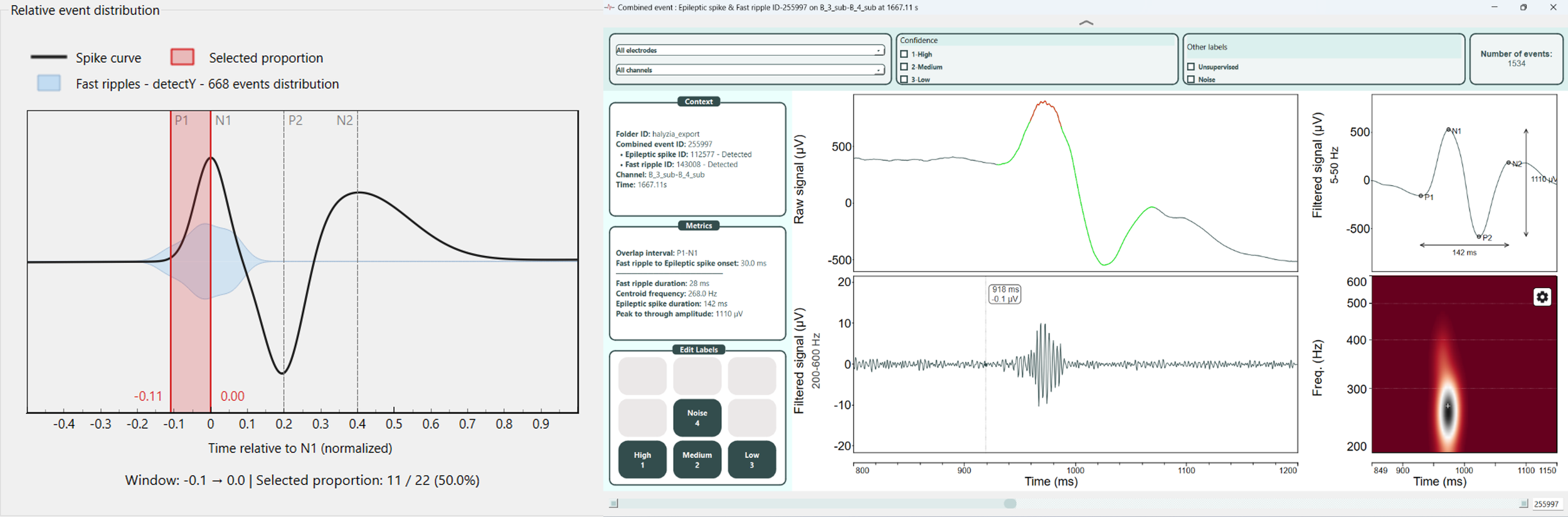
Figure : Combined event detection in Halyzia . On the left hand side, the interactive window to set relative event distribution; on the right hand side, the event viewer displaying co-occuring biomarkers : an epileptic spike and a fast ripple.
References
Below is our poster on detection of combined interictal biomarkers with Halyzia®.
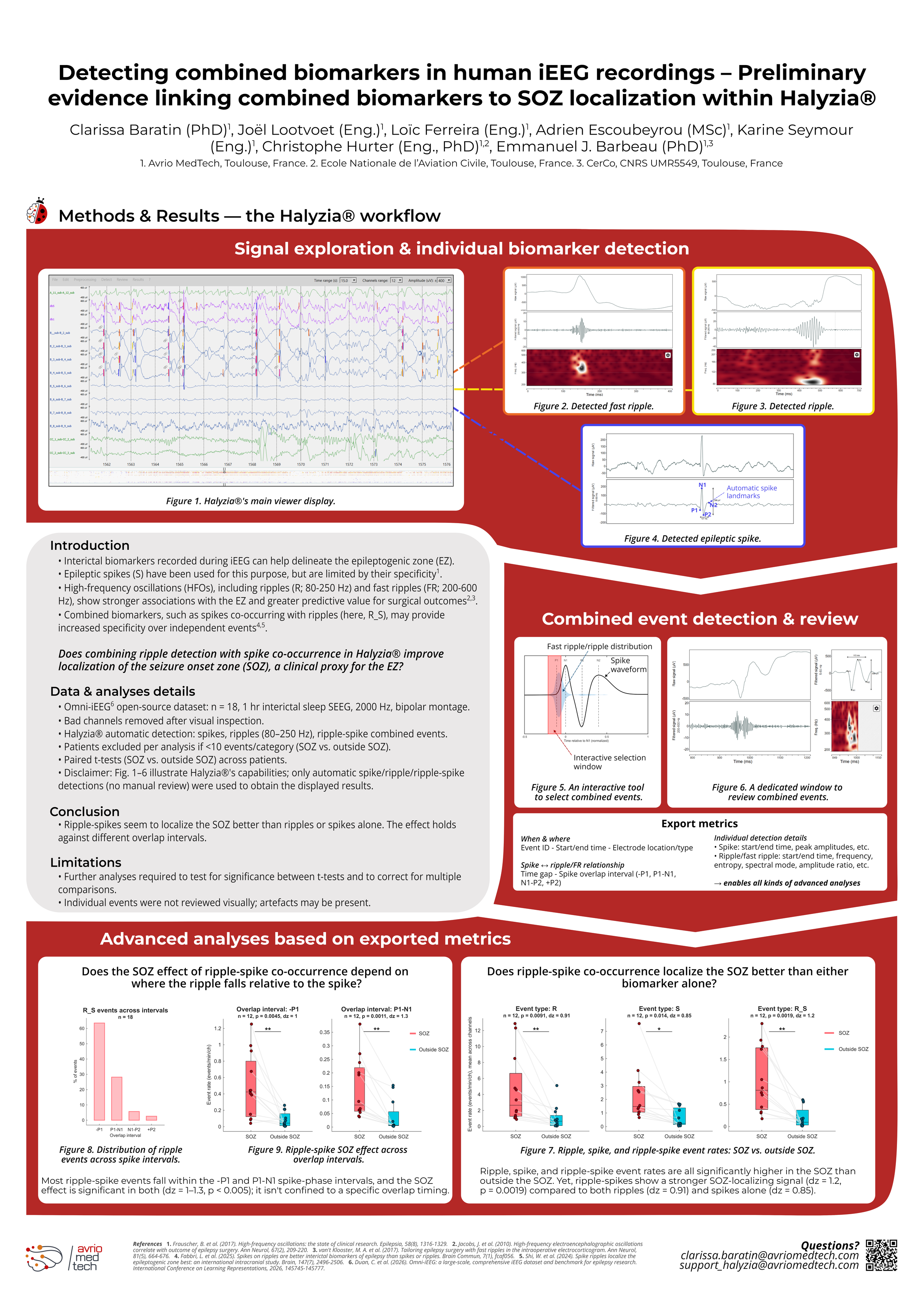
16th European Epilepsy Congress, 2026. First authored September 2026