
Filtering your SEEG signal
From noise to signal: SEEG filtering techniques
Filters are everywhere. They are found in electronic devices such as telephones, televisions, and even SEEG amplifiers – sometimes analogue, with electronic components, sometimes digital and directly integrated into software. Their purpose is always the same: to keep the signal of interest while attenuating the rest, often considered noise.
Why filter your SEEG signal?
Noise in stereroelectroencephalography (SEEG) signal can arise from several sources, including physiological artifacts such as muscle activity, eye blinks, eye movements, and cardiac activity, as well as non-physiological noise such as 50/60 Hz power-line interference, nearby electronic devices, and noise related to electrode–tissue impedance differences. Part of this noise is attenuated during the recording, but some of it remains in the recorded signals, which is why filtering might be necessary for your SEEG signals.
But removing noise is not the only reason to apply filters. The definition of noise itself depends on the focus of your analysis. If you are interested in low frequency oscillations, you might want to use a low-pass filter [Fig 1.a] to attenuate higher frequencies. In contrast, if you are interested in higher frequencies - fast ripples, for example - you might consider using a high-pass filter [Fig 1.b] to attenuate lower frequencies. If you are instead interested in a specific frequency band, which is often the case in SEEG analysis, you may want to combine high- and low-pass filters to create a band-pass filter [Fig 1.c]. And, finally, if you want to remove a specific frequency band, you can apply the opposite of a band-pass filter: the band-stop filter [Fig 1.d]. The most common SEEG band-stop filter is the notch filter, which is designed to remove precise frequencies (and notably 50/60 Hz power line noise).
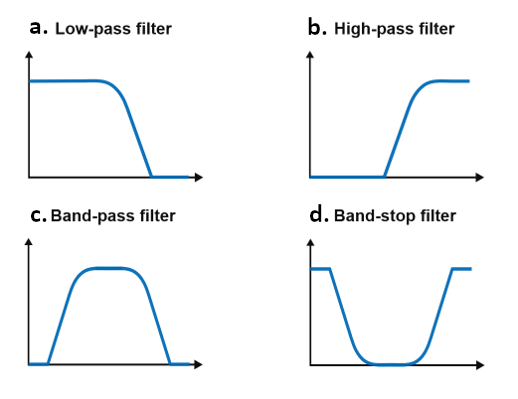
Fig. 1: Frequency responses of [a] low-pass filter [b] high-pass filter [c] band-pass filter [d] band-stop filter
Filter implementations: IIR vs FIR filters
All these filters can be implemented digitally. As digital filters, they can be divided into two main categories: Finite Impulse Response (FIR) filters and Infinite Impulse Response (IIR) filters.
The main difference between them lies in feedback: FIR filters do not use feedback, whereas IIR filters do. This means that, to compute each point of the filtered signal, FIR filters rely on current and past input values, whereas IIR filters also use past outputs. As a result, both types of filters have their advantages and disadvantages.
Because of the feedback, IIR filters need less memory to store computation coefficients, and they are usually faster than FIR filters due to their lower computational needs.
However, including feedback can also cause instability if the filter is not designed correctly, because small errors will impact every following output. This means that IIR filters can have stability issues that FIR filters do not have.
Another difference lies in the phase response: FIR filters have a linear phase response, whereas IIR filters have a nonlinear one, which distorts the shape of the signal. However, nonlinearity can be compensated by a method called forward-backward filtering (Smith et al., 2006).
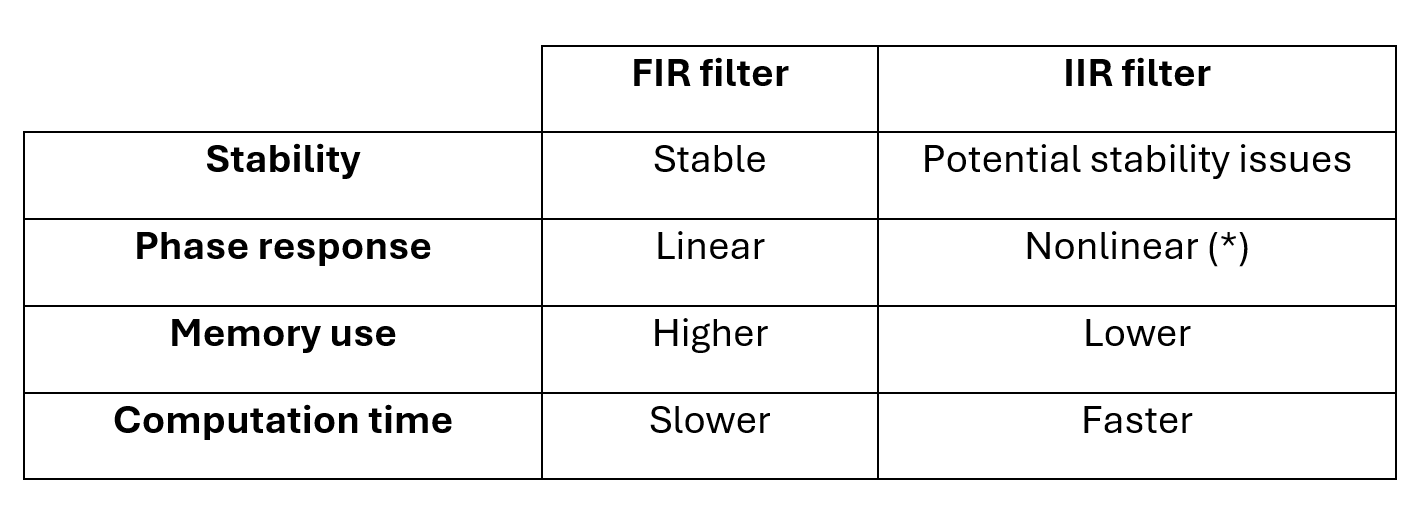
(*) can be corrected by forward-backward filtering
Which filter should you apply on your SEEG signal?
So, should you use a FIR or an IIR filter on your SEEG data? It depends on your needs. If you are focusing on fast ripples, for example, FIR filters may better preserve the high-frequency oscillations (Bénar et al., 2010). If you simply want to filter your data quickly for a visual inspection, an IIR filter is often preferred due to its computational efficiency. To remove 50/60 Hz line noise, a notch filter – typically implemented as an IIR filter – is commonly used. However, if you are interested in broadband activity and your signal is clean, you may not need to apply such filter.
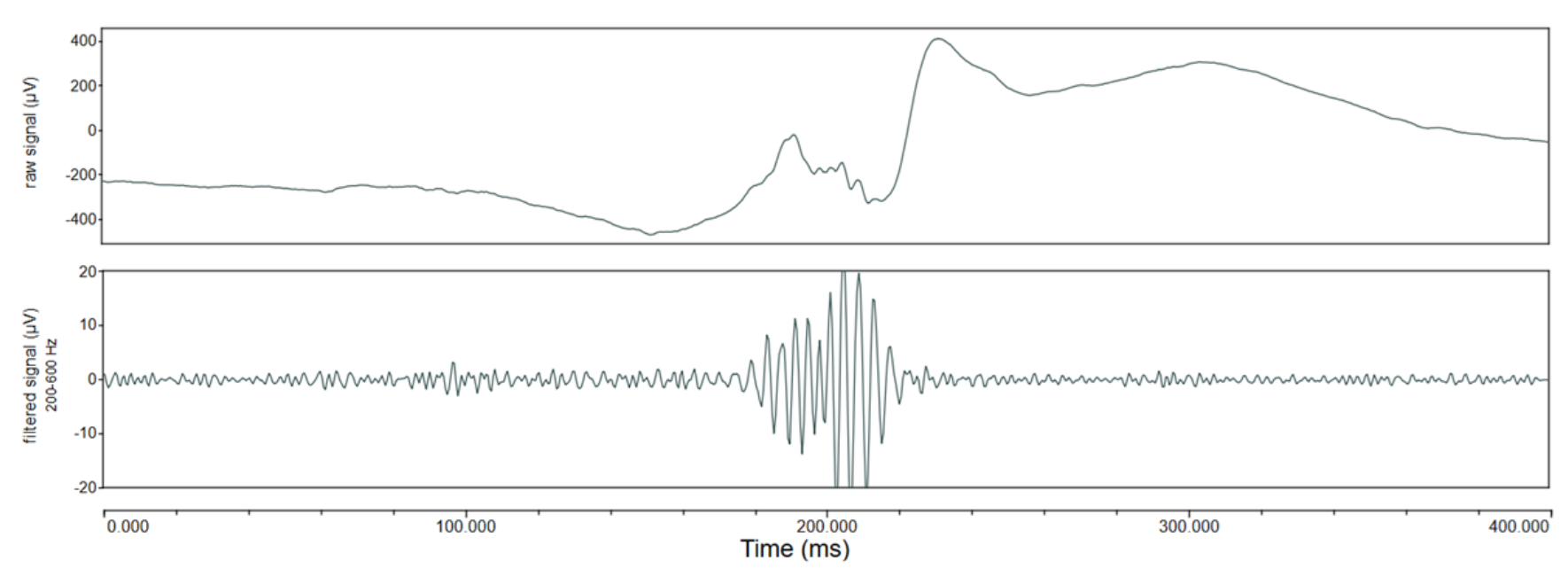
Example of raw (top) and filtered (bottom) fast ripple on Halyzia© using an 8th-order IIR bandpass [200-600 Hz]
In short, the type of filter you need depends on your study objectives. But in any case, filters can be of great help to improve your analyses on noisy signals.
All filters previously discussed are implemented in Halyzia© and can be applied as either permanent filters to preprocess your signal, or visual filters to explore your signal.
If you want to learn more about FIR and IIR filters, we highly recommend reading the articles in the references section below.
Authors: Antonin Biancheri, Clarissa Baratin - first published June 8th, 2026
References:
Bénar, C. G., Chauvière, L., Bartolomei, F., & Wendling, F. (2010). Pitfalls of high-pass filtering for detecting epileptic oscillations: a technical note on “false” ripples. Clinical Neurophysiology, 121(3), 301-310.
Smith, J. O. (2007). Introduction to digital filters: with audio applications(Vol. 2). W3K Publishing.
Additional references:
De Cheveigné, A., & Nelken, I. (2019). Filters: when, why, and how (not) to use them. Neuron, 102(2), 280-293.
Mercier, M. R., Dubarry, A. S., Tadel, F., Avanzini, P., Axmacher, N., Cellier, D., ... & Oostenveld, R. (2022). Advances in human intracranial electroencephalography research, guidelines and good practices. Neuroimage, 260, 119438.
Widmann, A., Schröger, E., & Maess, B. (2015). Digital filter design for electrophysiological data–a practical approach. Journal of neuroscience methods, 250, 34-46.